Eggs & Dairy
Parmesan cheese nutrition facts
A 1 undetermined oz (28 g) serving of parmesan cheese provides 119 calories, 8 g protein, 4 g carbohydrate, and 8 g fat — about 27% of its calories from protein, 13% from carbohydrate, and 60% from fat. The interactive label below toggles between a serving and 100 g.
Calorie split
| Nutrient | Per 1 undetermined oz (28 g) | Per 100 g |
|---|---|---|
| Calories | 119 | 420 |
| Protein | 8 g | 28 g |
| Total carbohydrate | 4 g | 14 g |
| Total fat | 8 g | 28 g |
Vitamins & minerals
Per serving (28 g)
- Vitamin A (RAE)
- 74.3 mcg
- Vitamin E
- 0.15 mg
- Vitamin K
- 0.48 mcg
- Thiamin (B1)
- 0.01 mg
- Riboflavin (B2)
- 0.10 mg
- Niacin (B3)
- 0.02 mg
- Vitamin B6
- 0.02 mg
- Folate (DFE)
- 1.70 mcg
- Vitamin B12
- 0.40 mcg
- Magnesium
- 9.64 mg
- Phosphorus
- 178 mg
- Zinc
- 1.19 mg
- Copper
- 0.01 mg
- Manganese
- 0.02 mg
- Selenium
- 9.75 mcg
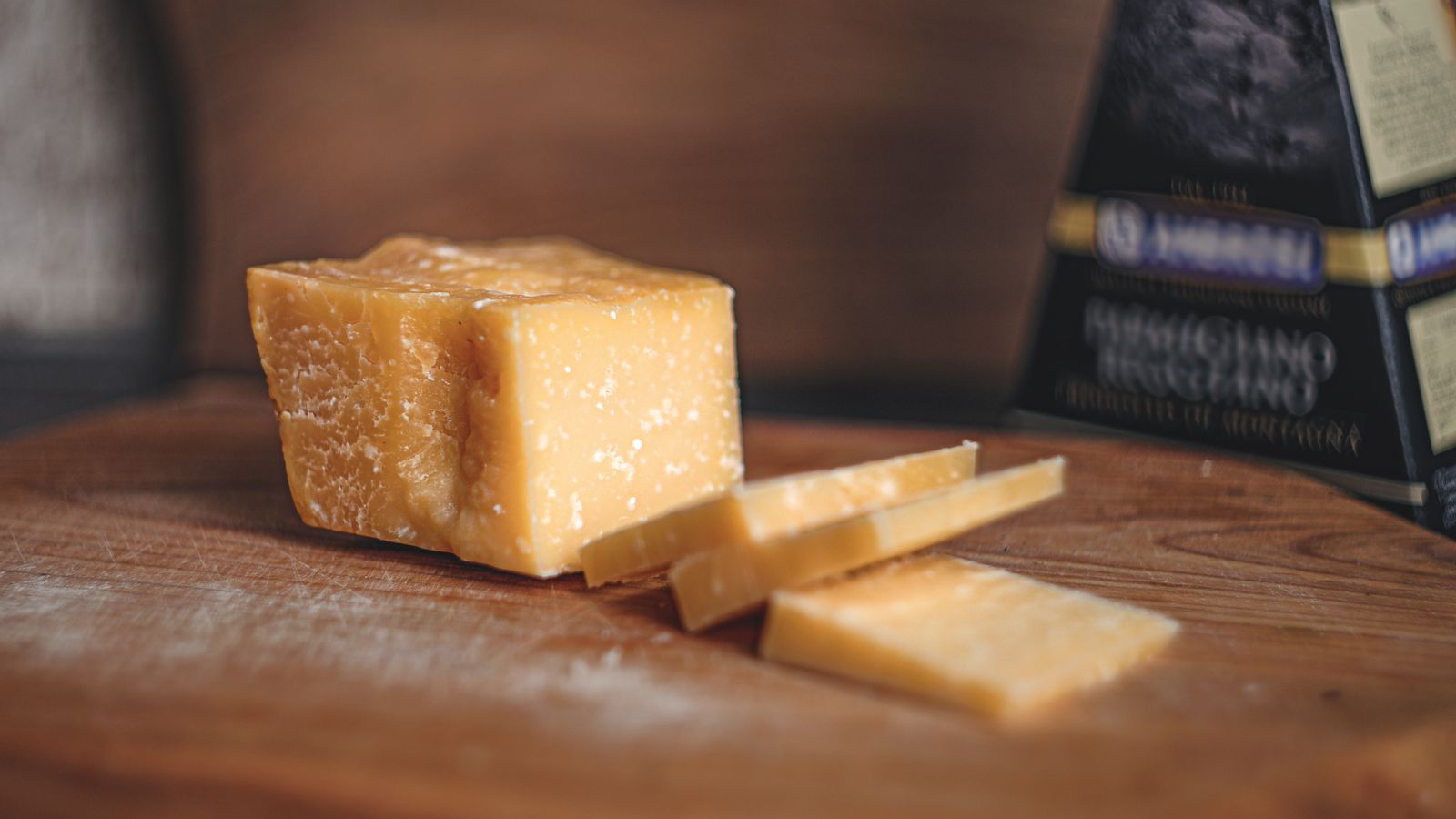
Photo by Ahimsa - OM on Pexels
Selecting, storing & prepping parmesan cheese
- Selecting
- True Parmigiano-Reggiano is aged a minimum of 12 months and often much longer, developing the characteristic gritty white crystals (tyrosine) that signal deep flavor — generic "parmesan" sold pre-grated is usually a younger, milder cheese.
- Storing
- A whole or partial wedge keeps 3-4 weeks refrigerated when wrapped in wax paper or parchment, then loosely in plastic. Pre-grated parmesan dries out faster and is best used within a week or two of opening.
- Prepping
- Grating parmesan fresh just before serving preserves far more aroma and flavor than pre-grated versions, which lose volatile compounds in storage.
Storage guidance from the USDA FoodKeeper database (FSIS, Cornell University, and the Food Marketing Institute).
Nutrition highlights
Per 1 undetermined oz (28 g), parmesan cheese is a good source of Calcium, Selenium, Vitamin B12, Protein, Phosphorus, and Zinc.
Relatively high in Saturated Fat and Sodium per serving — worth noting if you are limiting them.
% of the FDA Daily Value per 1 undetermined oz (28 g) serving.
Key metrics
Nutrient density
Per 100 kcal, parmesan cheese delivers about 5% of a Daily Value on average across 22 beneficial nutrients. The score is its percentile for that measure among the 177 foods in our database — higher means more nutrition per calorie. How this is calculated.
- More calcium than 99% of foods · 93% of eggs & dairy
- More protein than 97% of foods · 100% of eggs & dairy
- More vitamin A than 93% of foods · 73% of eggs & dairy
Density counts protein, fiber, and vitamins and minerals (not fat, sodium, or sugar), each capped so a single nutrient can’t dominate, with a calorie floor so very-low-calorie foods aren’t overstated. It measures nutrition per calorie within our database — a useful guide, not a complete verdict on how “healthy” a food is.
Similar foods & swaps
The closest eggs & dairy to parmesan cheese by nutrition (per 100 g), and how each differs.
Protein quality
As an animal-source protein, parmesan cheese is a complete protein — it supplies all nine essential amino acids on its own, so it doesn’t need to be paired with another protein source.
Questions
- How many calories are in parmesan cheese?
- A 1 undetermined oz (28 g) serving of parmesan cheese has about 119 calories. Per 100 g, it has 420 calories — a very high calorie density.
- How much protein is in parmesan cheese?
- Parmesan cheese provides about 8 g of protein per 1 undetermined oz (28 g) serving, which is 16% of the Daily Value — a good source.
- What are the macros in parmesan cheese?
- Per serving, parmesan cheese has roughly 8 g protein, 4 g carbohydrate, and 8 g fat. By calories, that is 27% protein, 13% carbohydrate, and 60% fat.
- Is parmesan cheese high in protein?
- Parmesan cheese has a protein density of about 6.8 g per 100 kcal, and 27% of its calories come from protein. Foods above roughly 10 g per 100 kcal are generally considered protein-dense.
- What vitamins and minerals are in parmesan cheese?
- Per 1 undetermined oz (28 g), parmesan cheese is a notable source of Calcium, Selenium, Vitamin B12, Phosphorus, and Zinc. The label above lists the full micronutrient profile with % Daily Values.
- What is the nutritional value of parmesan cheese?
- Per 1 undetermined oz (28 g), parmesan cheese has 119 calories, 8 g protein, 4 g carbohydrate, and 8 g fat, plus notable amounts of Calcium, Selenium, Vitamin B12, Phosphorus, and Zinc. See the full nutrition facts label above for every vitamin and mineral.
Use it
More eggs & dairy
References & methodology
- Data source: U.S. Department of Agriculture, Agricultural Research Service — FoodData Central, FDC ID 171247 (public domain).
- Daily Values: FDA Nutrition Facts label, 2016 update (adults and children aged 4+).
- Source claims: a serving supplying 10–19% of the Daily Value is a “good source”; 20% or more is an “excellent source” (FDA, 21 CFR 101.54).
- Calorie split: Atwater general factors — 4 kcal/g for protein and carbohydrate, 9 kcal/g for fat.
- Last reviewed: June 2026. Values are typical figures and vary with variety, ripeness, and preparation.
NutriFactsHub. “Parmesan cheese Nutrition Facts.” https://nutrifactshub.com/foods/parmesan-cheese