Seafood
Lobster nutrition facts
A 1 undetermined cup (145 g) serving of lobster provides 129 calories, 28 g protein, 0 g carbohydrate, and 1 g fat — about 91% of its calories from protein, 0% from carbohydrate, and 9% from fat. The interactive label below toggles between a serving and 100 g.
Calorie split
| Nutrient | Per 1 undetermined cup (145 g) | Per 100 g |
|---|---|---|
| Calories | 129 | 89 |
| Protein | 28 g | 19 g |
| Total carbohydrate | 0 g | 0 g |
| Total fat | 1 g | 1 g |
Vitamins & minerals
Per serving (145 g)
- Vitamin A (RAE)
- 1.45 mcg
- Vitamin E
- 1.45 mg
- Thiamin (B1)
- 0.03 mg
- Riboflavin (B2)
- 0.02 mg
- Niacin (B3)
- 2.65 mg
- Vitamin B6
- 0.17 mg
- Folate (DFE)
- 15.9 mcg
- Vitamin B12
- 2.07 mcg
- Magnesium
- 62.4 mg
- Phosphorus
- 268 mg
- Zinc
- 5.87 mg
- Copper
- 2.25 mg
- Manganese
- 0.09 mg
- Selenium
- 106 mcg
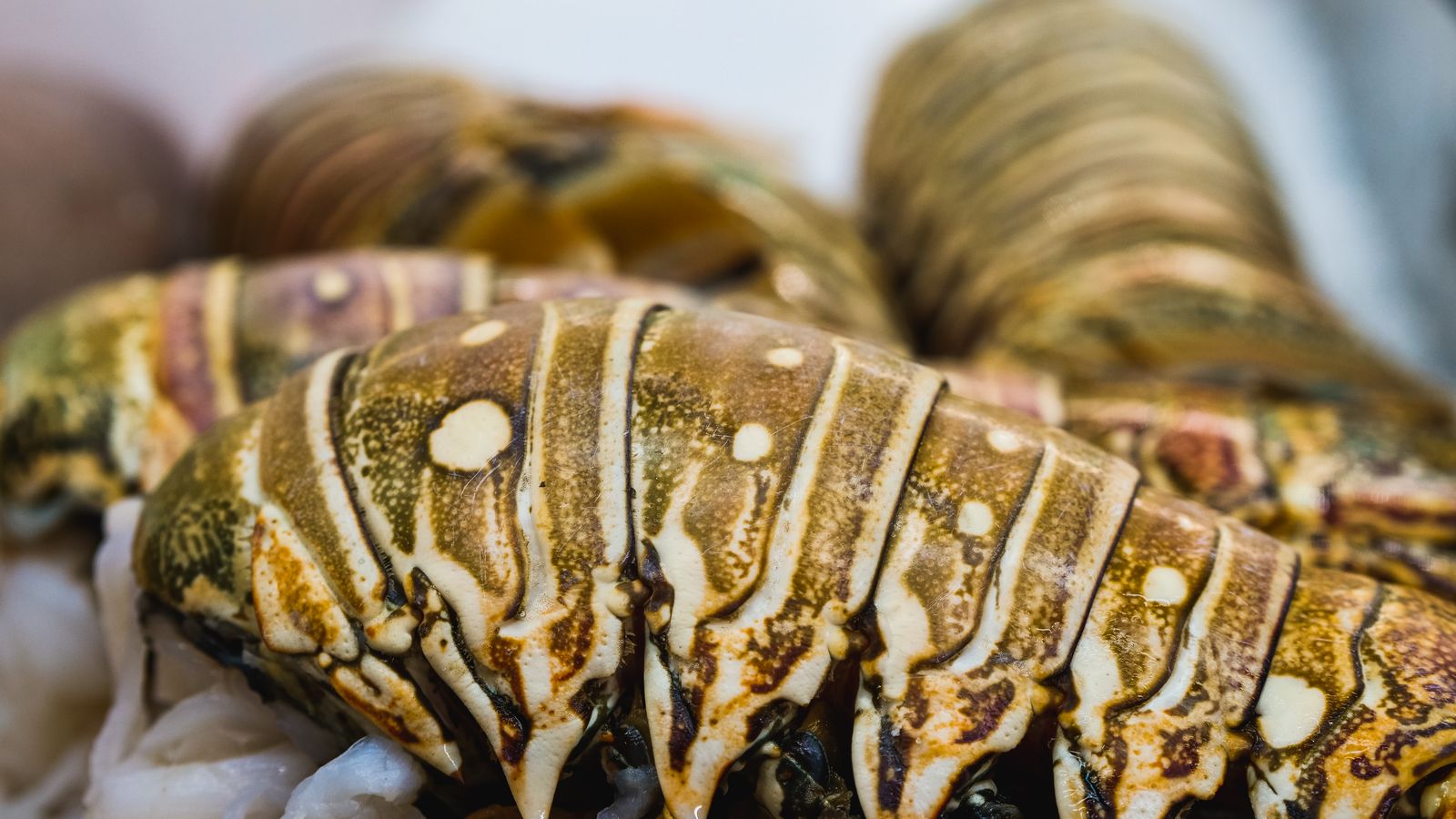
Photo by Kindel Media on Pexels
Selecting, storing & prepping lobster
- Selecting
- Live lobsters should be active and move their legs and tail when handled; a lobster that's sluggish or motionless may be near death, which affects both safety and flavor.
- Storing
- Live lobster is best cooked the same day it's bought; if needed, it can be refrigerated in a damp paper towel-lined container for up to 24 hours. Cooked lobster meat keeps 3-4 days refrigerated.
- Prepping
- Cooking lobster in well-salted, rapidly boiling water and shocking it in ice water immediately after helps stop the cooking process and keeps the meat from becoming rubbery.
Storage guidance from the USDA FoodKeeper database (FSIS, Cornell University, and the Food Marketing Institute).
Nutrition highlights
Per 1 undetermined cup (145 g), lobster is an excellent source of Copper, Selenium, Vitamin B12, Protein, Zinc, and Phosphorus and a good source of Niacin, Magnesium, Calcium, Vitamin E, and Vitamin B6.
Relatively high in Cholesterol and Sodium per serving — worth noting if you are limiting them.
% of the FDA Daily Value per 1 undetermined cup (145 g) serving.
Key metrics
Nutrient density
Per 100 kcal, lobster delivers about 14% of a Daily Value on average across 22 beneficial nutrients. The score is its percentile for that measure among the 177 foods in our database — higher means more nutrition per calorie. How this is calculated.
- More calcium than 80% of foods · 93% of seafood
Density counts protein, fiber, and vitamins and minerals (not fat, sodium, or sugar), each capped so a single nutrient can’t dominate, with a calorie floor so very-low-calorie foods aren’t overstated. It measures nutrition per calorie within our database — a useful guide, not a complete verdict on how “healthy” a food is.
Similar foods & swaps
The closest seafood to lobster by nutrition (per 100 g), and how each differs.
Protein quality
As an animal-source protein, lobster is a complete protein — it supplies all nine essential amino acids on its own, so it doesn’t need to be paired with another protein source.
Questions
- How many calories are in lobster?
- A 1 undetermined cup (145 g) serving of lobster has about 129 calories. Per 100 g, it has 89 calories — a low calorie density.
- How much protein is in lobster?
- Lobster provides about 28 g of protein per 1 undetermined cup (145 g) serving, which is 55% of the Daily Value — an excellent source.
- What are the macros in lobster?
- Per serving, lobster has roughly 28 g protein, 0 g carbohydrate, and 1 g fat. By calories, that is 91% protein, 0% carbohydrate, and 9% fat.
- Is lobster high in protein?
- Lobster has a protein density of about 21.3 g per 100 kcal, and 91% of its calories come from protein. Foods above roughly 10 g per 100 kcal are generally considered protein-dense.
- What vitamins and minerals are in lobster?
- Per 1 undetermined cup (145 g), lobster is a notable source of Copper, Selenium, Vitamin B12, Zinc, Phosphorus, and Niacin. The label above lists the full micronutrient profile with % Daily Values.
- What is the nutritional value of lobster?
- Per 1 undetermined cup (145 g), lobster has 129 calories, 28 g protein, 0 g carbohydrate, and 1 g fat, plus notable amounts of Copper, Selenium, Vitamin B12, Zinc, Phosphorus, and Niacin. See the full nutrition facts label above for every vitamin and mineral.
Use it
More seafood
References & methodology
- Data source: U.S. Department of Agriculture, Agricultural Research Service — FoodData Central, FDC ID 174209 (public domain).
- Daily Values: FDA Nutrition Facts label, 2016 update (adults and children aged 4+).
- Source claims: a serving supplying 10–19% of the Daily Value is a “good source”; 20% or more is an “excellent source” (FDA, 21 CFR 101.54).
- Calorie split: Atwater general factors — 4 kcal/g for protein and carbohydrate, 9 kcal/g for fat.
- Last reviewed: June 2026. Values are typical figures and vary with variety, ripeness, and preparation.
NutriFactsHub. “Lobster Nutrition Facts.” https://nutrifactshub.com/foods/lobster